
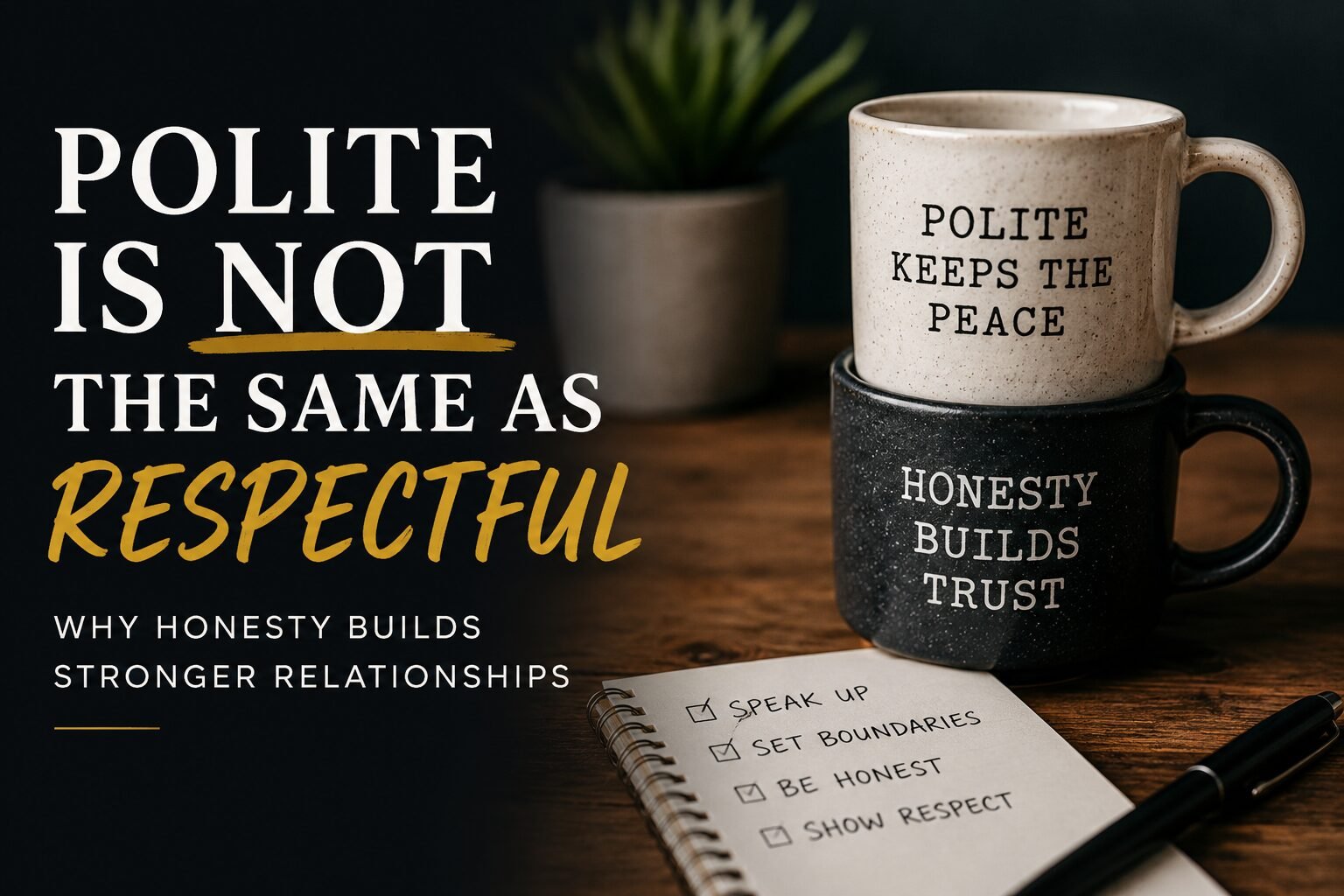
Polite Is Not the Same as Respectful
The Problem With Always Being Nice
Most people think being polite is a good thing. In most situations, they are right. Basic courtesy makes life easier. It helps people coexist, work together, and navigate disagreements without unnecessary hostility. There is certainly nothing wrong with being kind, considerate, or thoughtful toward others.
The problem arises when politeness stops being kindness and starts becoming avoidance. Many of us have said “it’s fine” when it wasn’t. We have agreed to things we did not want to do. We have withheld opinions, concerns, and frustrations because we did not want to create tension or disappoint someone. In those moments, what appears polite on the surface is often a form of dishonesty.
Over time, these small acts accumulate. They do not just create resentment. They create relationships where people know a carefully edited version of us rather than the real person. Eventually, we begin to wonder why others fail to understand us, while forgetting that we have spent years hiding what we truly think and feel.
The Hidden Cost of Keeping the Peace
Many people are conditioned from an early age to avoid conflict. We are taught to be agreeable, cooperative, and accommodating. Those lessons have value. Society would be exhausting if everyone felt compelled to share every thought exactly as it entered their mind. Restraint and tact are important social skills.
However, there is a difference between being tactful and being silent. There is a difference between choosing your battles and refusing to have them at all. Some people become so focused on maintaining peace that they begin sacrificing boundaries, honesty, and self-respect in the process.
Ironically, people who avoid conflict often end up creating larger conflicts later. The concern that should have been addressed months ago grows into resentment. The frustration that was never discussed becomes bitterness. The boundary that was never established continues to be crossed. What could have been resolved through a difficult five-minute conversation becomes a relationship problem that lasts for years.
Professionalism Is Not Agreement
This dynamic shows up frequently in the workplace. In fact, some of the most dysfunctional organizations I have encountered were also some of the most outwardly polite. Meetings were cordial. Emails were professional. Everyone appeared supportive and collaborative.
Yet the real conversations happened after the meeting ended. Concerns were expressed in hallways, parking lots, group texts, and private offices. People complained about decisions they never challenged. Employees expressed frustrations they never shared with supervisors. Leaders assumed everyone was aligned because nobody spoke up when it mattered.
That is not professionalism. Professionalism is not the absence of disagreement. Professionalism is the ability to engage disagreement respectfully and productively. Healthy organizations require people who are willing to ask difficult questions, challenge assumptions, and provide honest feedback. Without those things, organizations often become trapped by their own politeness.
Respect Requires Truth
One of the biggest misconceptions people have is that politeness and respect are interchangeable. They are not.
Respect often requires conversations that are uncomfortable. It requires telling a friend they are making a mistake. It requires giving constructive feedback to a colleague. It requires saying no when everyone expects you to say yes. Respect asks us to value honesty enough to risk temporary discomfort.
Of course, honesty should never be an excuse for cruelty. Some people pride themselves on “telling it like it is” when what they are really doing is being unnecessarily harsh. Honesty without empathy can be damaging. At the same time, empathy without honesty is often little more than avoidance disguised as kindness.
Many of the people who shaped us the most were not always comfortable to be around in the moment. The mentor who challenged our assumptions. The supervisor who delivered difficult feedback. The friend who told us something we did not want to hear. Those conversations may not have felt pleasant, but they were rooted in respect because they were rooted in truth.
A Question Worth Asking
The next time you find yourself holding back, consider asking yourself a simple question: Am I staying silent because speaking up would be unkind, or because speaking up would be uncomfortable?
Those are two very different things. One reflects compassion and wisdom. The other often reflects fear.
Learning the difference may be one of the most important relationship skills we ever develop. It affects our friendships, our families, our workplaces, and our leadership. It determines whether we build relationships based on appearances or relationships based on trust.
Trust is rarely built through endless politeness. Trust is built when people believe they are getting the real version of you. It is built when honesty and respect exist together. That combination is far more valuable than politeness alone.
Reflection Questions
- Where in your life are you choosing comfort over honesty, and what is that choice costing you?
- How might your relationships change if you focused less on avoiding discomfort and more on communicating respectfully and truthfully?