
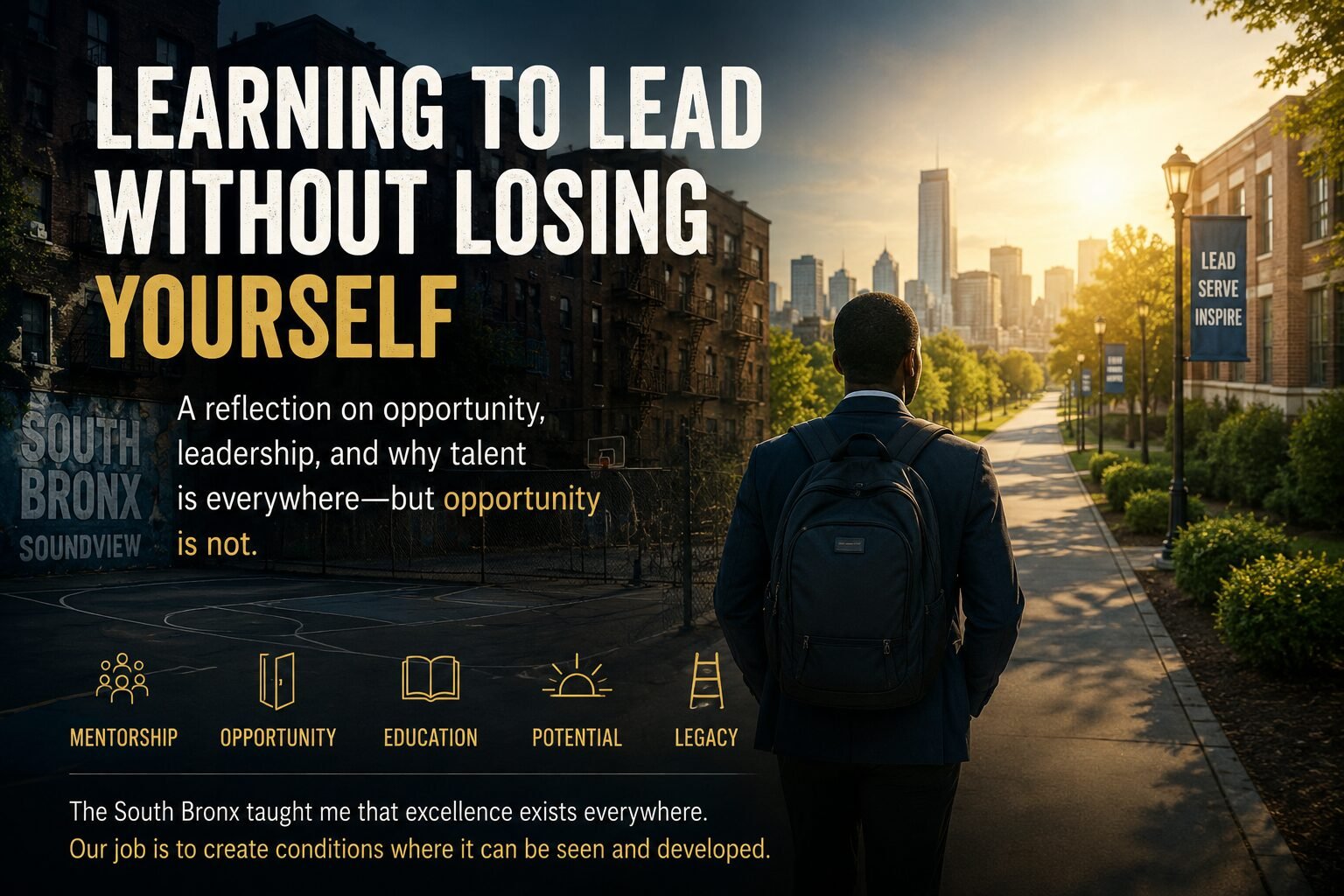
Learning to Lead Without Losing Yourself
A reflection on opportunity, leadership, and why I still believe talent is our nation’s most overlooked resource.
Before you read this post, I hope you’ll take a few minutes to watch my recent presentation, “Learning to Lead Without Losing Yourself,” delivered as one of six featured Sprint Speakers during the closing session of the 2026 ACUHO-I Campus Home. Live! Conference. If the message resonates with you, I would be grateful if you shared the video with someone who needs encouragement. Maybe it’s a young professional, a college student, or a young man or woman still trying to discover what they are capable of becoming. Sometimes the right message arrives at exactly the right moment.
Standing on that stage was one of the greatest professional honors of my career. Yet when I stepped away from the podium, I found myself thinking more about the people who never had the opportunity to stand where I was standing. This is something that drives much of what I believe and do.
Success Looks Different Looking Back
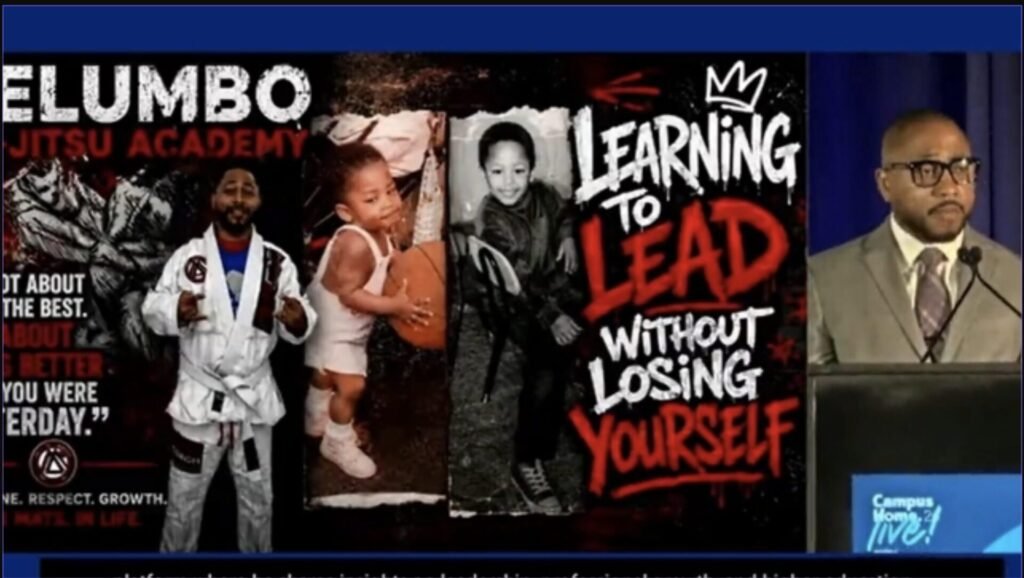
I have been a bit inconsistent with my blogging. The past six months have been a season of loss, transition, and reflection. Thankfully, I am in a much better place mentally today. As I lightly joked on the podcast, life was lifing. Between the demands of leading a residence life program, traveling, writing, speaking engagements, grieving the loss of family, and simply trying to keep life balanced, something had to give for a while. Looking back, I think that pause was necessary because it gave me the time and space to reflect on what this journey has truly meant and, perhaps more importantly, what it has been preparing me for.
People often ask how someone from the Soundview section of the South Bronx eventually became a university administrator, earned a doctorate, published scholarship, and now speaks at national conferences. For years, I answered that question by talking about hard work, determination, and perseverance. Those things certainly mattered. But the older I become, the less satisfied I am with that explanation because it leaves out an uncomfortable truth.
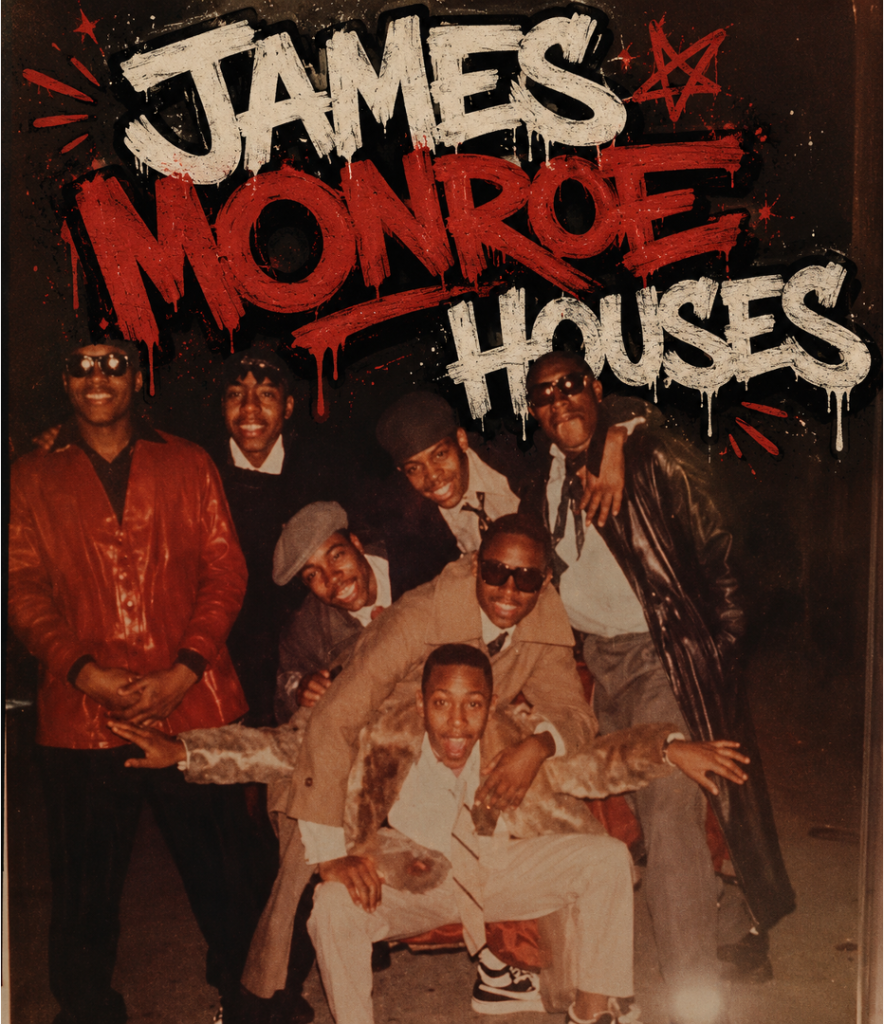
I was never the only talented person where I grew up. In fact, one of the unintended consequences of calling someone “exceptional,” “special,” or “one of a kind” is that it subtly suggests the people they grew up alongside were somehow less gifted, less intelligent, less creative, or less hardworking. That simply was not my experience. I was surrounded by brilliance. I knew natural leaders, gifted athletes, entrepreneurs before they knew the word entrepreneur, artists, musicians, and people whose resilience and ingenuity still inspire me today.
I also think there is a danger for those of us who manage to make it out of statistically difficult circumstances. If we’re not careful, we can begin to believe the narrative that we were somehow uniquely destined to succeed while everyone else simply lacked what we had. That mindset is not only inaccurate, it distracts us from the larger challenge. Our goal should not be to celebrate the existence of one Oprah Winfrey or one Tyler Perry. Our goal should be to build communities and institutions where dozens, hundreds, or even thousands of people with extraordinary talent have the opportunity to realize their potential.
The Greatest Myth We Tell Ourselves
One of the biggest myths in America is that success belongs primarily to the most talented or hardest-working people. If you believe that, I encourage you to listen to a podcast episode that I unfortunately cannot recall by name. One point that has stayed with me was its discussion of the enormous cost of maintaining golf courses and how many Fortune 500 CEOs spend significant time on them, not because they are avoiding work, but because relationship-building and access often happen there rather than in the office. It was a reminder that success is shaped not only by intelligence and effort but also by networks, opportunity, and proximity to power.
Talent opens some doors. Hard work opens others. But opportunity determines which doors are available in the first place.
Growing up in the Bronx, I knew brilliant people. I knew natural leaders. I knew gifted athletes, entrepreneurs before they knew the word entrepreneur, comedians who could command any room, artists who could create beauty from almost nothing, and young people whose emotional intelligence far exceeded their years. They possessed every bit as much potential as anyone I would later meet in graduate school or professional conferences. Many simply never received the same opportunities.
That realization has become more profound with age. I no longer look back on my neighborhood and primarily remember poverty or violence. I remember possibility. I remember excellence that too often went unseen. I remember friends whose stories ended far too early, not because they lacked ability, but because circumstances eventually became stronger than opportunity.
For many years I carried survivor’s guilt. Why did I receive a second chance when someone else did not? Why did an English teacher see something in me? Why did a judge choose mercy? Why did mentors keep opening doors for me while other equally deserving people watched doors remain closed? Those questions still do not have easy answers.
Learning Without Losing Yourself
Leaving the Bronx was exciting, but it was also unsettling.
College introduced me to environments where very few people shared my experiences. I quickly learned that success involved more than academic ability. It required understanding unwritten rules that no one explicitly taught. I learned how to navigate professional spaces, communicate differently depending on the audience, and adapt to institutional cultures that often felt unfamiliar.
Being who I am in this world, there were moments when adaptation felt less like growth and more like performance. There were times I questioned whether I truly belonged. There were moments when stereotypes entered the room before I did. There were assumptions about competence that required me to prove myself repeatedly. Those experiences are hardly unique for many professionals from historically marginalized communities, particularly within predominantly White institutions. They shape how you move, how you speak, and sometimes even how much of yourself you allow others to see. Eventually, I realized the real challenge was not simply becoming successful.
It was becoming successful without losing the person who left the Bronx.
Mentorship Changed Everything
If opportunity opened the first door, mentorship kept opening the rest.
Throughout my career, people invested in me long before they had any obligation to do so. They challenged me, corrected me, encouraged me, and sometimes believed in my potential before I believed in it myself. Looking back, I realize that representation certainly mattered. Seeing people who looked like me in leadership affirmed what was possible. I thank SUNY Albany for that early in my college career.
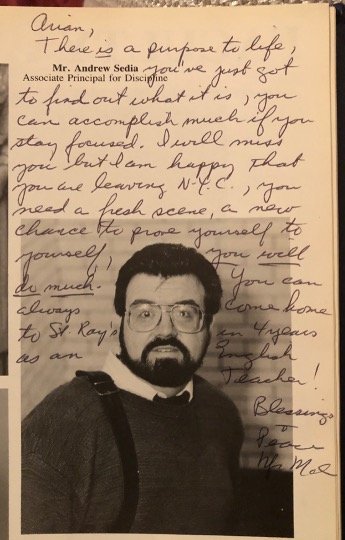
But investment mattered even more. Some of my most influential mentors did not share my background. Rest in peace and shout out to Mr. McCauley (high school English teacher) and Prof Charles Tarlton (my undergrad political science advisor). What they shared was a willingness to recognize potential and help cultivate it. They understood something that has become central to my own leadership philosophy. Leadership is not measured by titles, offices, or organizational charts. Leadership is measured by what happens because you were there.
That lesson has fundamentally changed how I supervise staff, mentor emerging professionals, and interact with students. Every conversation is an opportunity to help someone recognize something in themselves that they may not yet see.
The Responsibility of Leadership
Several of my previous blog posts have wrestled with themes of representation, belonging, and creating opportunity. Those ideas are not separate from this conversation. They are extensions of it. Whether I have written about working in spaces where very few supervisors looked like me, navigating restrictive environments in higher education, or reflecting on the importance of mentorship, the underlying question has remained remarkably consistent. Who gets the opportunity to flourish?
That question guides much of my work today. It influences how I hire, how I supervise, how I evaluate potential, and even how I think about organizational culture. My responsibility is not simply to identify talent. My responsibility is to help create environments where talent can emerge, regardless of where someone began their journey. The doctorate hanging on my wall represents years of work, but it also represents my grandmother, my mother, my aunt, teachers, supervisors, mentors, colleagues, and friends who invested in me along the way. No meaningful achievement is ever entirely individual.
Looking Ahead
Walking off that stage at ACUHO-I, I realized the sprint sessions were never really about the speakers. It was about every young person who has questioned whether they belong. It was about every first-generation student trying to decode unfamiliar systems. It was about every professional who has felt pressure to become someone else in order to succeed. It was about every child growing up in neighborhoods too often defined by deficits instead of possibility.
The South Bronx gave me many lessons. The greatest one was this: excellence exists everywhere. It is not confined to affluent neighborhoods, prestigious universities, or corner offices. It has always existed in overlooked communities, waiting for someone willing to recognize it.
As leaders, educators, and mentors, perhaps our greatest responsibility is not discovering talent.
It is ensuring that talent has a genuine opportunity to become excellence.
Because after everything I’ve experienced, one truth has only become clearer.
Talent is everywhere.
Opportunity still is not.
Reflection
- Who helped create opportunities that changed the course of your life, and have you thanked them?
- How are you using your own position, influence, or leadership to create opportunities for someone who might otherwise be overlooked?