Representation for Me, But Not for Thee
It’s a strange thing to be lectured, albeit tacitly, about the importance of representation in the workplace.
Over the course of my professional career, I have had exactly one supervisor who looked like me. One.
My experience has been far from unique. For many people across countless professions, the norm is to work alongside and be led by people whose backgrounds, identities, and life experiences differ significantly from their own.
That reality never struck me as unusual. It was simply the world as it existed.
As a Black man working in higher education, I entered a profession where most of my colleagues and supervisors were White women. Statistically true look it up…don’t be mad at facts. Many were excellent leaders! Some were not. The same could be said for any demographic group. What mattered most was not whether they looked like me. What mattered was whether they were competent, ethical, invested in my development, and committed to the mission of serving students. Clock that.
Along the way, I learned something important.
You can learn from people who do not share your identity.
You can be mentored by people who do not share your lived experience.
You can grow under the leadership of people whose backgrounds differ dramatically from your own.
In fact, for many professionals from historically marginalized groups, that has never been a choice. It has been a necessity.
That is why it is always striking to watch some people react when the demographic reality shifts and they find themselves no longer surrounded primarily by people who look like them.
For individuals who have spent most of their careers seeing reflections of themselves in leadership positions, meetings, professional conferences, and organizational charts, becoming one voice among many can feel unfamiliar. Sometimes that discomfort is interpreted as a problem rather than simply a new experience.
What is particularly fascinating is how often this reaction emerges in fields that regularly discuss the D word.
Representation is frequently framed as a universal good until representation includes someone who does not fit the preferred image.
The conversation can subtly shift from advocating for different perspectives to advocating for familiar perspectives.
Those are not always the same thing.
The irony is difficult to ignore.
Many of the professionals now expressing concern about working alongside or being supervised by individuals from different backgrounds are experiencing a reality that countless others have navigated for decades. The difference is that for some, this is a new experience rather than a lifelong one.
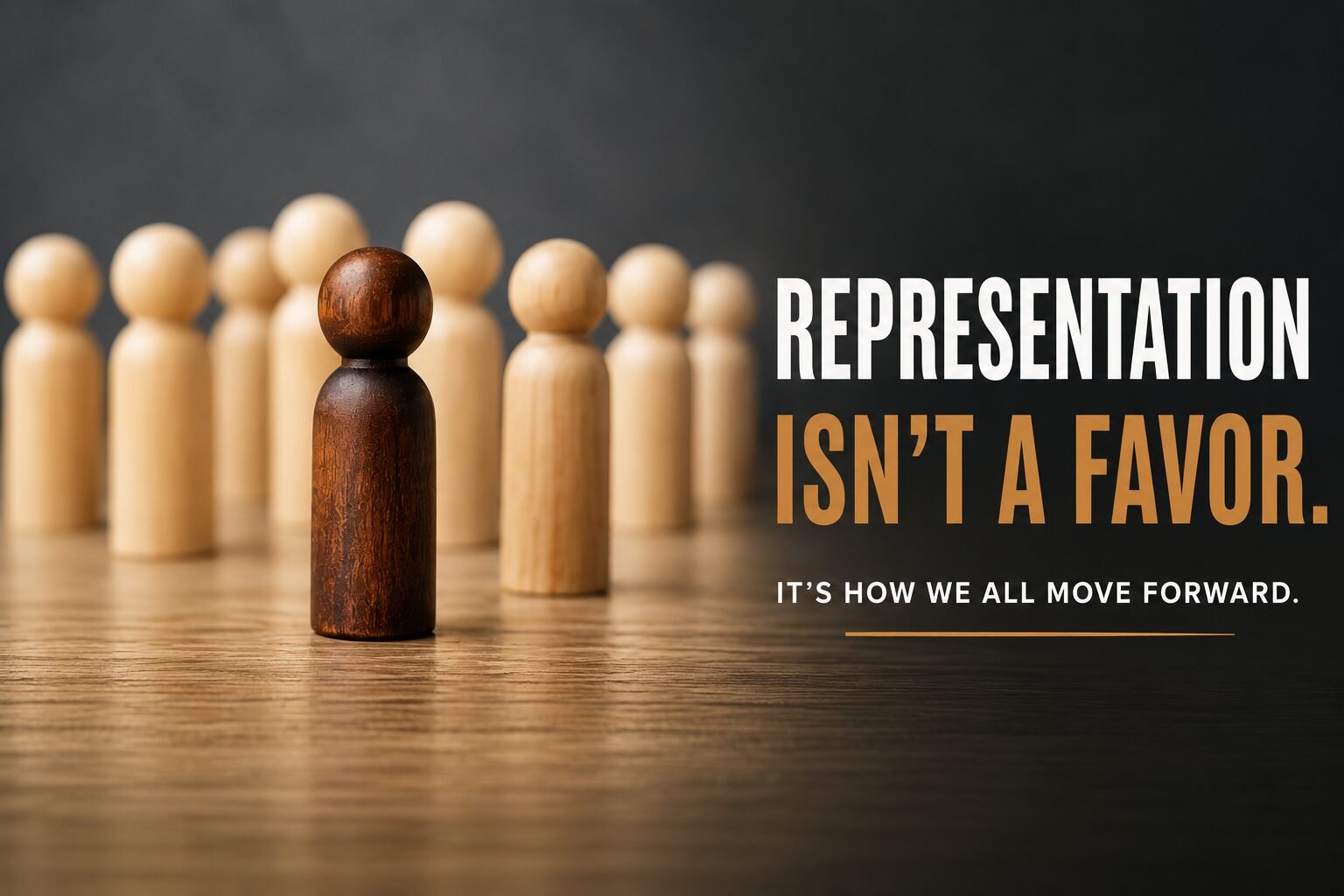
To be clear, representation matters.
It matters for students.
It matters for employees.
It matters because people benefit from seeing examples of what is possible. The strongest teams bring different perspectives, challenge assumptions, and often produce stronger outcomes.
But representation should never be confused with exclusivity.
The goal cannot be that every person is only comfortable being supervised by someone who shares their race, gender, religion, sexual orientation, or cultural background. That is not realistic. That is simply demographic preference dressed up in more acceptable language.
A truly inclusive workplace requires a different skill set.
It requires the ability to see competence before similarity.
It requires the humility to learn from people whose experiences differ from our own.
It requires recognizing that effective leadership is not confined to any one demographic category.
Most importantly, it requires an honest examination of our own biases.
The truth is that bias is not limited to one political ideology, one race, one gender, or one generation. Every one of us carries assumptions. Every one of us has comfort zones. Every one of us has blind spots.
The work is not eliminating discomfort.
The work is learning how to function effectively despite it.
Perhaps that is why I find these conversations so interesting.
For many of us, being different in the room was never an occasional experience. It was simply Tuesday.
We learned to build relationships across difference because we had no alternative. We learned to trust, collaborate, and grow under leaders who did not look like us because that was the environment we inherited.
The lesson I took from those experiences was not that representation is unimportant.
The lesson was that representation and competence are not competing values. They can coexist.
And if we genuinely believe in inclusion, then we must be willing to apply its principles even when they challenge our own preferences, assumptions, and comfort.
Especially then.
Reflection Questions
- Have you ever examined how much of your professional comfort comes from competence versus familiarity?
- If diversity is truly a value, how should we respond when we find ourselves in environments where we are no longer part of the majority?