As I reflect on my career in student affairs and campus housing, I keep returning to a question that many seasoned professionals discuss quietly but rarely examine publicly.
To what extent are we creating the very behaviors we later criticize in new professionals?
Over the past several years, I have heard countless conversations about changes in the profession. Experienced professionals often express frustration about what they perceive as a lack of initiative, reduced critical thinking, increased dependency on supervisors, and hesitation in decision-making among newer staff members.
There may be some truth to those observations. There may also be another explanation.
What if some of those behaviors are not personal shortcomings? What if they are rational responses to the environments we create through our onboarding, training, supervision, and organizational culture?
The Work Is More Complex Than It Used to Be
Before critiquing newer professionals, we should acknowledge a reality that is often overlooked. The work today is harder. A Residence Life Coordinator or Assistant Director is navigating challenges that many of us did not encounter at the same scale when we entered the profession.
Today’s professionals face increasing student mental health concerns, greater parental involvement, growing legal and compliance expectations, social media scrutiny, housing occupancy pressures, and an expectation of near-constant accessibility through technology.
The institutional risk associated with many decisions has also increased significantly. As a result, what some supervisors interpret as hesitation may actually be caution. What appears to be risk aversion may be a professional recognizing that one poor decision can have consequences for students, staff, and the institution.
That context matters. At the same time, I believe there is another factor worth examining.
Are We Training Professionals Like Students?
One thing I have noticed throughout my career is that many professional staff training programs borrow heavily from undergraduate leadership training models.
Many of the approaches originally designed for Resident Assistants, Orientation Leaders, Peer Mentors, and student organizations have gradually made their way into professional staff development. The result can feel contradictory.
We tell new professionals:
- You are a supervisor.
- You are a professional.
- You are responsible for student well-being.
- You oversee budgets, facilities, conduct processes, and staff.
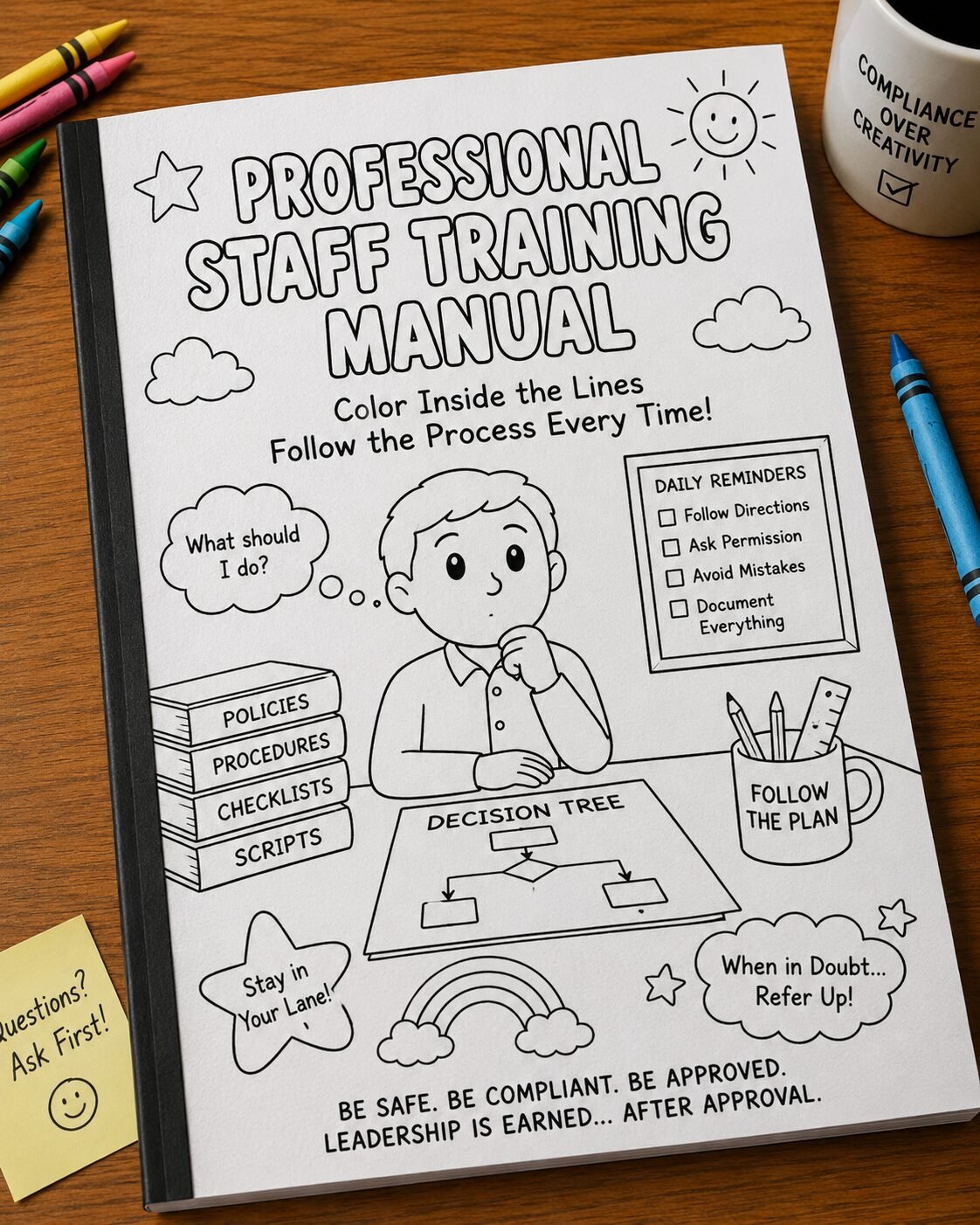
Then we ask them to spend portions of training participating in activities that feel developmentally mismatched with those expectations. Coloring activities. Marshmallow tower competitions. Icebreakers that belong in a first-year seminar. Highly structured exercises where every answer is guided and every outcome predetermined.
The message becomes confusing. We expect professional judgment while simultaneously creating environments that reward compliance and dependence.
The Difference Between Pedagogy and Andragogy
The issue may be better understood through the distinction between pedagogy and andragogy. Pedagogy assumes learners are dependent on instructors for direction and knowledge. The instructor drives the learning process and determines what information is important. Andragogy assumes adult learners bring experiences, perspectives, and existing knowledge into the room. Learning becomes collaborative, relevant, and centered on solving real problems.
Many new professionals are being trained pedagogically while being expected to perform professionally. That contradiction deserves attention.
When training consistently communicates, “Wait for instructions,” “Follow the script,” and “Ask permission before acting,” it should not surprise us when employees become hesitant to exercise independent judgment. We may be unintentionally teaching dependency while expecting autonomy.
Compliance Versus Judgment
The deeper issue may not be coloring books or icebreakers. The deeper issue may be what we choose to prioritize. Think about the average professional staff training schedule. How much time is spent discussing:
- Policies
- Procedures
- Documentation
- Reporting requirements
- Compliance expectations
Now compare that to the time spent discussing:
- Ethical decision-making
- Leadership
- Conflict management
- Ambiguity
- Professional judgment
- Critical thinking
Organizations often say they want leaders. Yet much of our onboarding process focuses on producing compliant employees. Compliance is important. Policies matter. Documentation matters. But leadership requires something more.
The reality of student affairs is that most situations do not come with perfect answers. The most valuable professionals are often those who can navigate ambiguity, assess risk, consult appropriately, and make reasonable decisions when there is no clear roadmap.
Those skills require practice.
A Different Approach
Perhaps the question should not be, “How do we make training more fun?” Perhaps the question should be, “How do we make training more meaningful?” Imagine replacing some traditional activities with:
- Real case studies.
- Problem-solving labs.
- Ethical dilemmas.
- Leadership discussions.
- Independent projects.
- Structured reflection on successes and failures.
These approaches communicate something powerful. Trust. Trust often accelerates professional growth faster than oversight. When people are given ownership, challenged to think critically, and allowed to wrestle with uncertainty, they begin developing the judgment we claim to value.
The Question We Should Be Asking
I am not convinced that newer professionals are fundamentally different from previous generations. What I am questioning is whether our systems are producing the outcomes we say we want.
If we spend weeks teaching compliance, months rewarding risk avoidance, and years encouraging people to seek permission before acting, then a lack of initiative should not come as a surprise. The larger question may not be why new professionals seem different.
The larger question may be what assumptions about professionalism are embedded in our onboarding, training, supervision, and organizational culture. If we truly want initiative, judgment, confidence, and critical thinking, those traits must be practiced during training, not merely listed as expectations afterward.
Otherwise, we risk training followers and then spending years wondering where the leaders went.
Reflective Questions
- What aspects of your organization’s training model encourage independent judgment, and which ones unintentionally encourage dependency?
- Are we preparing professionals to think critically and lead, or are we primarily preparing them to comply?