Strange Fruit
There is a reason people who want absolute power eventually become interested in who gets to vote.
Voting is not the entirety of democracy. It never has been. Democracies also require independent courts, a free press, functioning legislatures, civil liberties, peaceful transfers of power, and citizens willing to hold government accountable. But the ballot remains one of the primary ways ordinary people decide who gets access to the machinery of government.
That is precisely why the history of voter suppression deserves our attention.
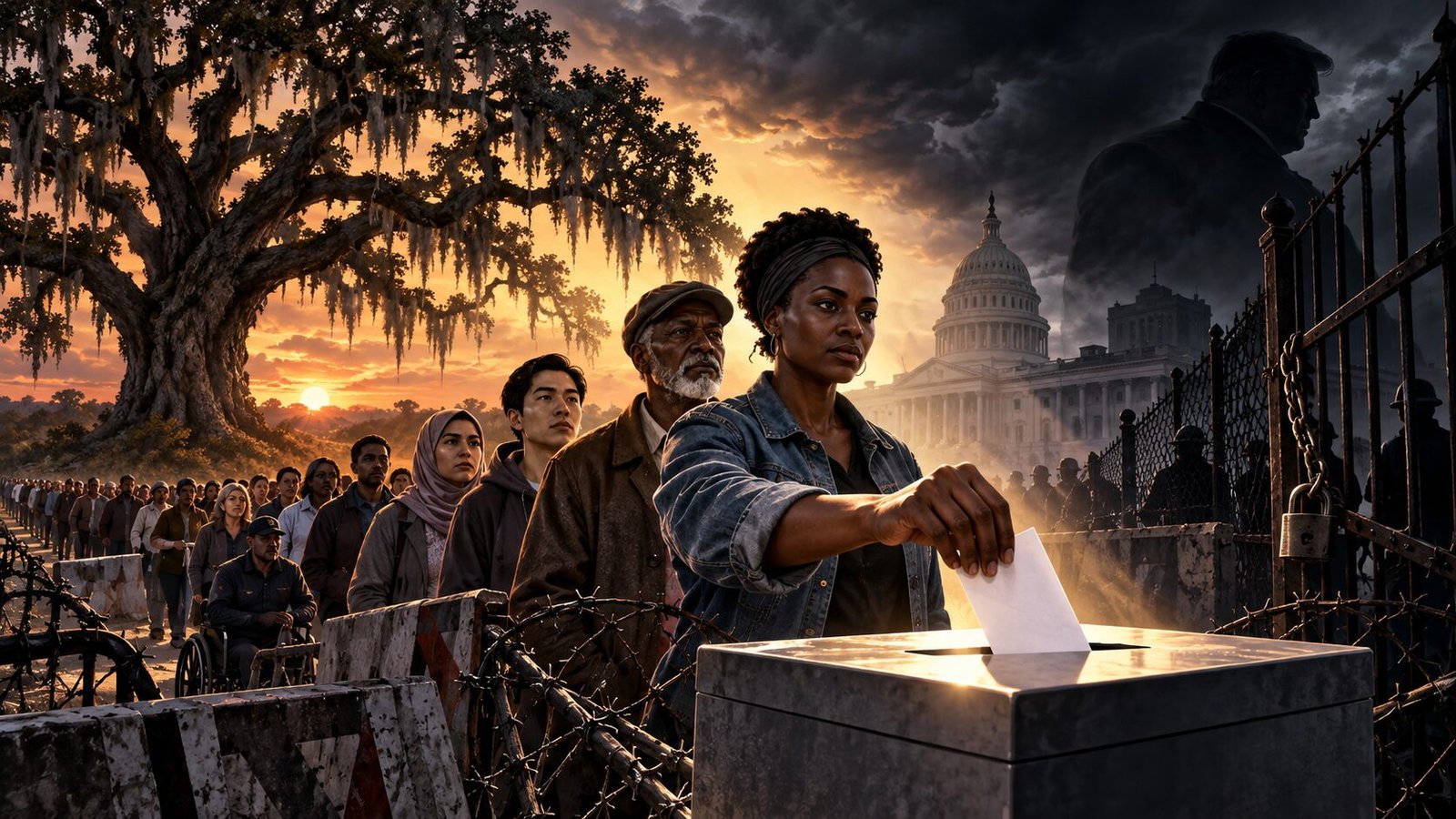
After the Civil War, the Fifteenth Amendment prohibited denying Black men the vote because of race. Yet across the South, governments developed ways to technically acknowledge that constitutional right while making it extraordinarily difficult for Black citizens to exercise it. Poll taxes, literacy tests, intimidation, complicated registration systems, economic retaliation, and outright violence became tools of political control. The Voting Rights Act of 1965 was necessary because nearly a century of constitutional promises had not been enough.
The methods change.
The objective does not.
Modern voting restrictions may involve strict identification requirements, aggressive voter-roll purges, reduced voting opportunities, registration barriers, polling-place closures, or rules that disproportionately burden particular populations. Research continues to find that many such restrictions fall most heavily on voters of color.
And this is where American history connects to a much larger global story.
Authoritarian governments do not always eliminate elections. In fact, many modern autocrats prefer to keep them.
They simply work to make elections less meaningful.
Opposition candidates can be disqualified. Independent media can be weakened. Districts can be manipulated. Government resources can benefit incumbents. Voters can be intimidated. Rules can be rewritten. Eventually, citizens may still technically cast ballots while having less and less ability to change who holds power.
Freedom House has documented this pattern across authoritarian and democratic-backsliding governments around the world: elections remain, while meaningful competition gradually disappears.
That is why I reject the idea that voting does not matter because voting alone cannot fix everything.
Of course it cannot.
Neither can one protest.
One court case.
One journalist.
One organization.
Democracy survives through an ecosystem of participation.
History teaches us that democratic decline is often gradual. Institutions are weakened one decision at a time. Norms become negotiable. Abnormal behavior becomes normal. Citizens become exhausted and disengage.
And eventually people look around and wonder when everything changed.
Usually, it was changing the entire time.
So yes, organize. Protest. Read. Challenge authority. Support independent journalism. Demand accountability.
But when Election Day comes?
Go fucking vote.
Five Books I Recommend
Give Us the Ballot — Ari Berman
If you want to understand the modern struggle over voting rights in America, I would start here. Berman traces what happened after passage of the Voting Rights Act of 1965 and explains the political counteroffensive that developed against expanded voting access. It is particularly useful because it connects race, political power, courts, legislation, and voting into one historical narrative.
One Person, No Vote — Carol Anderson
Anderson focuses directly on voter suppression and makes clear that contemporary restrictions did not appear out of nowhere. She examines voter ID requirements, gerrymandering, polling-place closures, and other mechanisms that can make political participation more difficult, particularly for communities of color. If you read only one book specifically about voter suppression, make it this one.
How Democracies Die — Steven Levitsky and Daniel Ziblatt
This book changed how many people think about democratic collapse. The central lesson is uncomfortable: modern democracies frequently do not end through dramatic military coups. They can deteriorate gradually as elected leaders weaken institutions, disregard norms, attack opponents, and consolidate power from within the democratic system itself.
On Tyranny — Timothy Snyder
This is the shortest book on my list and probably the easiest starting point for someone who has fallen out of the habit of reading. Snyder draws lessons from twentieth-century authoritarianism and translates them into practical warnings for citizens living in democratic societies. You can read it quickly. You will probably think about it much longer.
Strongmen: Mussolini to the Present — Ruth Ben-Ghiat
This one goes directly at the psychology and political strategy of authoritarian leadership. Ben-Ghiat examines how strongman governments use propaganda, masculinity, corruption, violence, attacks on truth, and promises of order to build and maintain political power. It provides the international context necessary to recognize that authoritarian behavior tends to follow recognizable patterns.
Read Before You React
I know reading a political book requires more effort than watching a thirty-second video.
That is exactly why I am recommending these. Social media is very good at telling us what to be angry about. Books can help us understand why it is happening, how we got here, and whether we have seen it before. Read broadly. Disagree with authors. Check their evidence. Read people outside your ideological comfort zone.
But read.Democracy needs voters. It also desperately needs readers.