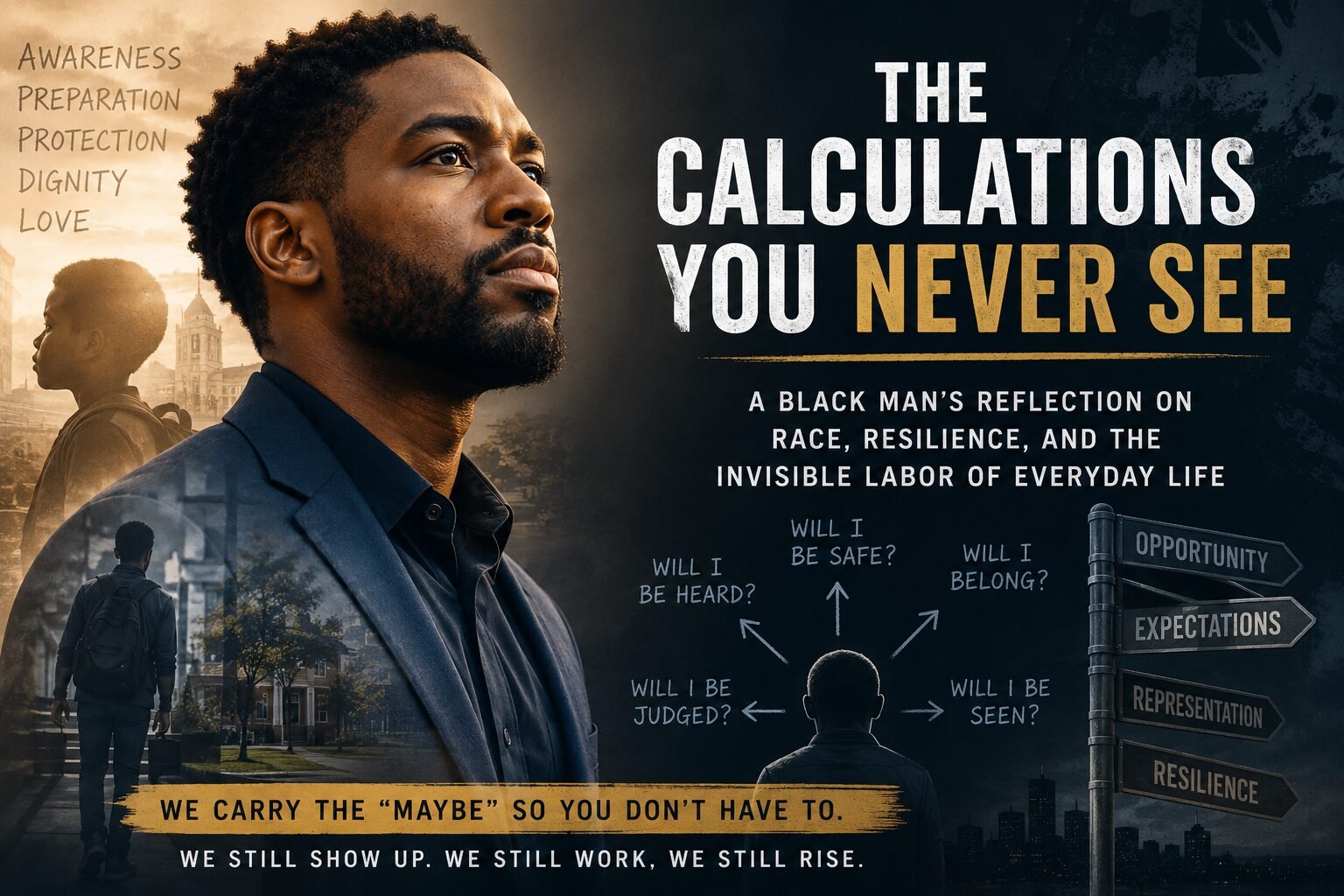
The Calculations You Never See
There is a sentence in a recent social media post that has stayed with me for days:
“The fear lives in the maybe.” I have thought about those words often because they capture something many Black Americans understand instinctively but struggle to explain to people who have never had to live it.
The “maybe” is exhausting.
It is not the certainty that someone will treat you unfairly. It is the uncertainty that they might. It is the mental energy spent evaluating situations before they happen. It is asking questions that many people never have to ask because the answers have never been matters of survival, dignity, or opportunity. As I read the post from a white mother raising a Black son, I found myself nodding. Not because our lives are identical, but because the calculations she described have been part of my life for as long as I can remember.
Growing up in the South Bronx taught me resilience long before I understood the word. It also taught me awareness. I learned to read rooms before I entered them. I learned to pay attention to tone, body language, neighborhoods, and who held authority. Those lessons were never presented as fear. They were presented as wisdom. They were survival skills passed from one generation to the next because someone loved us enough to prepare us for a world that did not always see us fully.
That is why conversations about race often miss the point. Too many people reduce racism to individual acts of hatred. They ask whether someone intended to discriminate or whether a particular event can be proven beyond all doubt to have been motivated by race. Those are important questions, but they are not the only questions.
The more persistent reality is anticipation. It is wondering whether introducing yourself differently will change how someone perceives you. It is choosing your words carefully during a disagreement because you know anger is not interpreted equally. It is deciding how to dress, how to carry yourself, and even how loudly to laugh depending on the environment. None of these decisions feel extraordinary anymore because they become routine. They simply become part of life.
Over the years, I have written about racial battle fatigue, belonging, and what it means to lead in environments where your competence is often evaluated differently. I have also written about representation and how, throughout my career, I have rarely worked for supervisors who looked like me. Those experiences were never about seeking people who shared my identity simply for comfort. They were about understanding what it feels like to exist in spaces where you are constantly aware that you may be interpreted differently than everyone else. That awareness follows you into every aspect of life.
When I walk into a professional meeting, I want people to notice my preparation before they notice my race. When I teach, supervise, or speak publicly, I know I represent more than myself whether I asked for that responsibility or not. A mistake risks becoming confirmation of someone else’s stereotype. Success often becomes an exception rather than evidence that the stereotype was flawed in the first place. That burden is difficult to explain unless you have carried it.
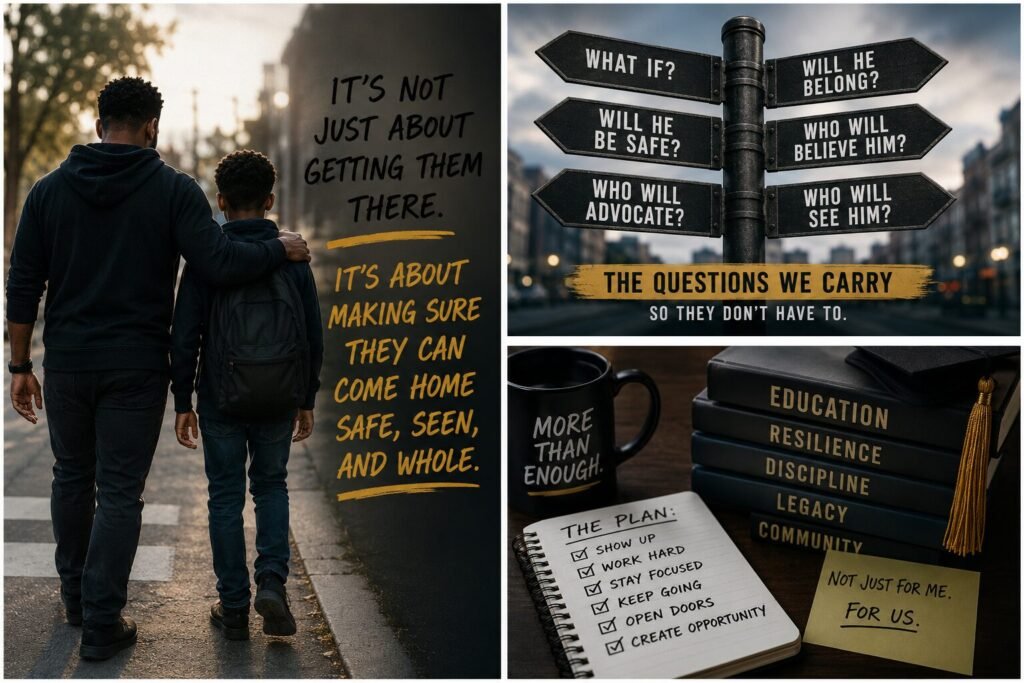
The social media post described a mother evaluating birthday parties, churches, baseball leagues, and friendships through the lens of risk assessment. Some readers may interpret those choices as overly cautious. I do not. I recognize them. They reflect the same calculations many Black families quietly make every day. They are not born from paranoia. They are born from history, experience, and stories passed from parents to children who simply want them to come home safely with their dignity intact One part of the post struck me especially deeply. The author wrote that being welcomed and being protected are not the same thing.

She is right.
I have been welcomed into rooms where I was still underestimated. I have received opportunities while simultaneously feeling the need to prove I deserved them more than anyone else in the room. I have been praised for being “articulate,” “professional,” or “different,” compliments that often reveal more about the speaker’s expectations than about my abilities.
Those moments are subtle, but they accumulate. That accumulation is something I discussed in my scholarship on racial battle fatigue. It is rarely one catastrophic event. It is hundreds of ordinary moments that require additional emotional labor. It is the constant interpretation of situations that others move through without conscious thought. Eventually, the mental energy required simply to navigate the day becomes invisible work that no performance evaluation will ever recognize.
I also think about the privilege of certainty. Many parents send their children into the world assuming they will be judged primarily as individuals. Many Black parents and parents of black children hope for that same reality but prepare their children for the possibility that they will not be. That preparation is an act of love, even though it is a conversation no parent should ever have to have.
As a Black man, I carry those lessons with me every day. I also refuse to allow them to define me. My journey from the South Bronx to earning a doctorate and leading within higher education was shaped by mentors who saw potential before titles. They reminded me that while I could not always control how I was perceived, I could control my character, my preparation, and my commitment to excellence.
Even so, excellence should never become a prerequisite for receiving basic dignity. That is perhaps the hardest truth to explain. Too often Black Americans feel compelled to be exceptional simply to be viewed as competent. We are encouraged to work twice as hard, obtain another credential, perfect our communication, avoid every possible mistake, and maintain composure under circumstances where others would be granted grace.
That expectation is unsustainable, yet many of us continue to meet it because we know the consequences of not doing so can be profound. When conversations arise after tragedies involving young Black men, people often focus on proving or disproving racial intent. Those facts matter, and they should be investigated carefully. But there is another reality that deserves equal attention. Long before the facts are known, many Black families recognize themselves in the uncertainty. They understand why questions arise. They understand why caution exists. They understand why the “maybe” carries so much weight.
For those who have never lived that experience, my hope is not that you leave this essay feeling guilty. My hope is that you leave more curious, more empathetic, and more willing to believe people when they describe realities different from your own. Listening is not agreement with every conclusion. Listening is acknowledging that someone else’s lived experience may reveal parts of the world you have never been required to see.
The other reality is this. Many of us carry these calculations every single day and then still get up the next morning. We go to school. We go to work. We lead organizations. We raise families. We earn degrees. We mentor others. We volunteer in our communities. We pursue excellence because we genuinely believe in the value of hard work. At the same time, we often feel an unspoken pressure to work just a little harder, prepare just a little more, smile just a little longer, and accomplish just a little extra, all to avoid being labeled lazy, mediocre, angry, or undeserving. That invisible labor rarely makes headlines.
But for many Black Americans, it has always been part of the job.
Reflective Questions
- What assumptions do you never have to think about because the world has rarely asked you to justify your humanity?
- If someone trusted you enough to share a reality different from your own, would your first response be to defend your perspective or to understand theirs?